How Polymarket's BTC Up/Down Markets Resolve
A Polymarket BTC Up/Down market resolves Up if the final price is at or above the price to beat. The price to beat is set at the start of the bucket and the final price at the end. Pending means that value has not arrived yet. On a 5 minute market, T60 is the settlement line, and Coinbase and Binance lines are for reference.
A Polymarket BTC Up/Down market asks one question: will Bitcoin's price at the end of a fixed window be at or above its price at the start? Each window, or bucket, has two reference values. The price to beat is the BTC value at the start of the bucket, and the final price is the value at the end. If the final price is equal to or greater than the price to beat, the market resolves Up; if it is lower, it resolves Down. Winning tokens then redeem for $1 and losing tokens for $0.
Where do the price to beat and final price come from?
Polymarket's Resolution page says Up/Down markets are resolved by Chainlink TWAP. Each market specifies an asset pair, a start time, and a duration. The time weighted average price at the start sets the price to beat, and the TWAP when the duration ends sets the final price. Both come from the same Chainlink TWAP stream. A TWAP is the asset's average price over a short lookback window, so a single print at the boundary has less influence on it than it would on a spot price.
For all five BTC timeframes Zoqo lists (5 minute, 15 minute, 1 hour, 4 hour, and 1 day), Polymarket's live rules name Chainlink's BTC/USD TWAP-60s data stream as the resolution source. Zoqo's site notes that a 5 minute market settles on T60, the average Chainlink price over 60 seconds. The 1 hour and daily markets moved from Binance candles to that same Chainlink feed on November 18, 2026.
Because the inputs and the comparison are fixed in advance, there is no UMA proposal and dispute step, as there is for event markets. The same observations always produce the same result.
What happens on a tie?
The rule is "equal to or greater than," so a final price exactly equal to the price to beat resolves Up. That is the rule on all five timeframes, and Zoqo's code applies the same inequality on the markets that settle this way. A tie is unlikely, but it means Up and Down are not perfect mirror images of each other.
What does a BTC Up/Down market look like from start to finish?
Here is a dated example from a BTC 5 minute market that ran from 4:50 to 4:55 PM ET on November 10, 2026. Zoqo labels the price to beat as "Target Price."
| Value | |
|---|---|
| Target Price (price to beat) | $73,809.51 |
| Final value shown at close | $73,760.52 |
| Outcome | Down |
The final value was below the price to beat, so Down tokens redeemed for $1 and Up tokens for $0. The next 5 minute bucket, 4:55 to 5:00 PM ET, opened with a Target Price of $73,760.52, the same value as the previous bucket's final price. For TWAP settled buckets, one bucket's final price becomes the next bucket's price to beat.
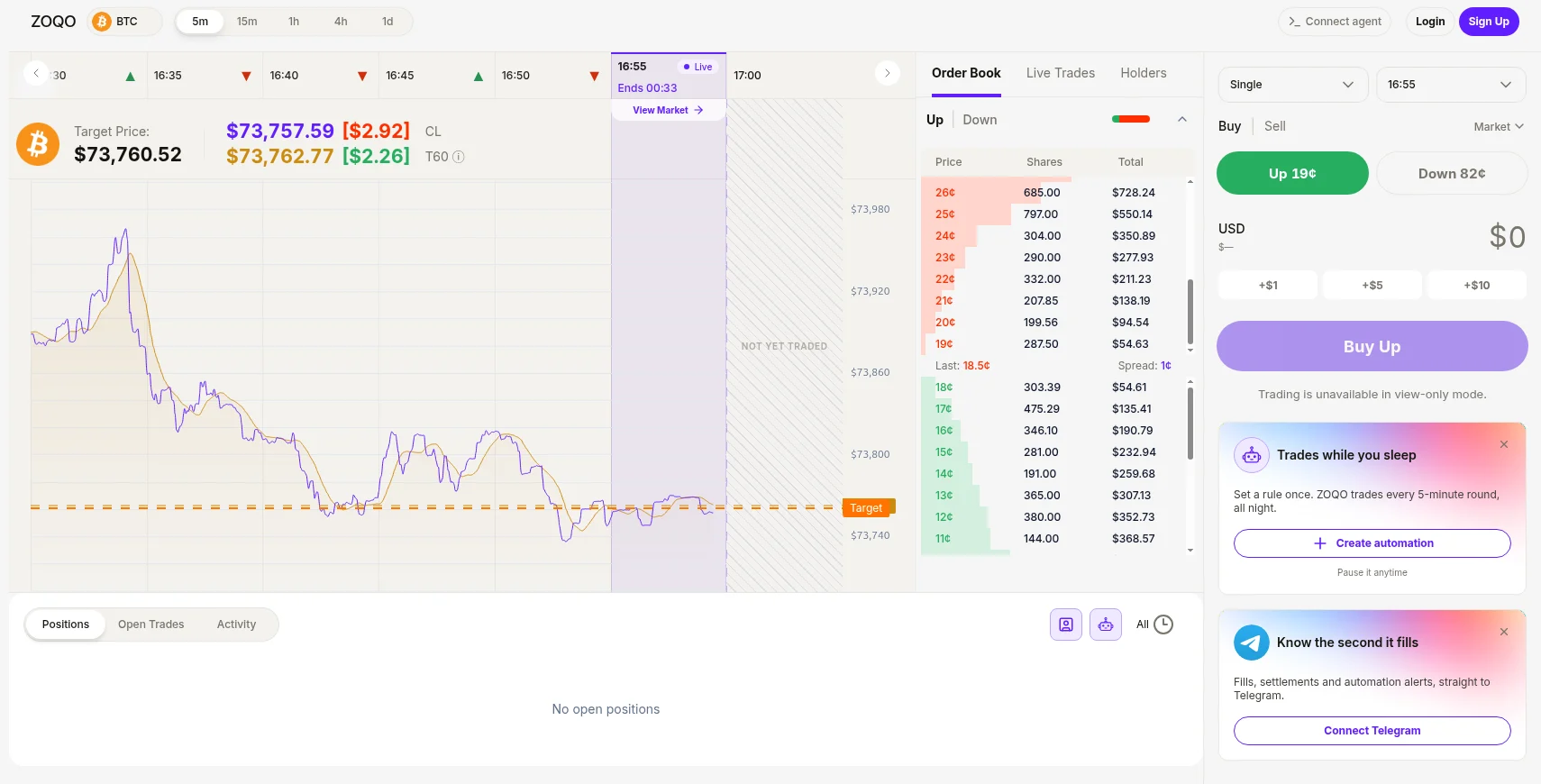
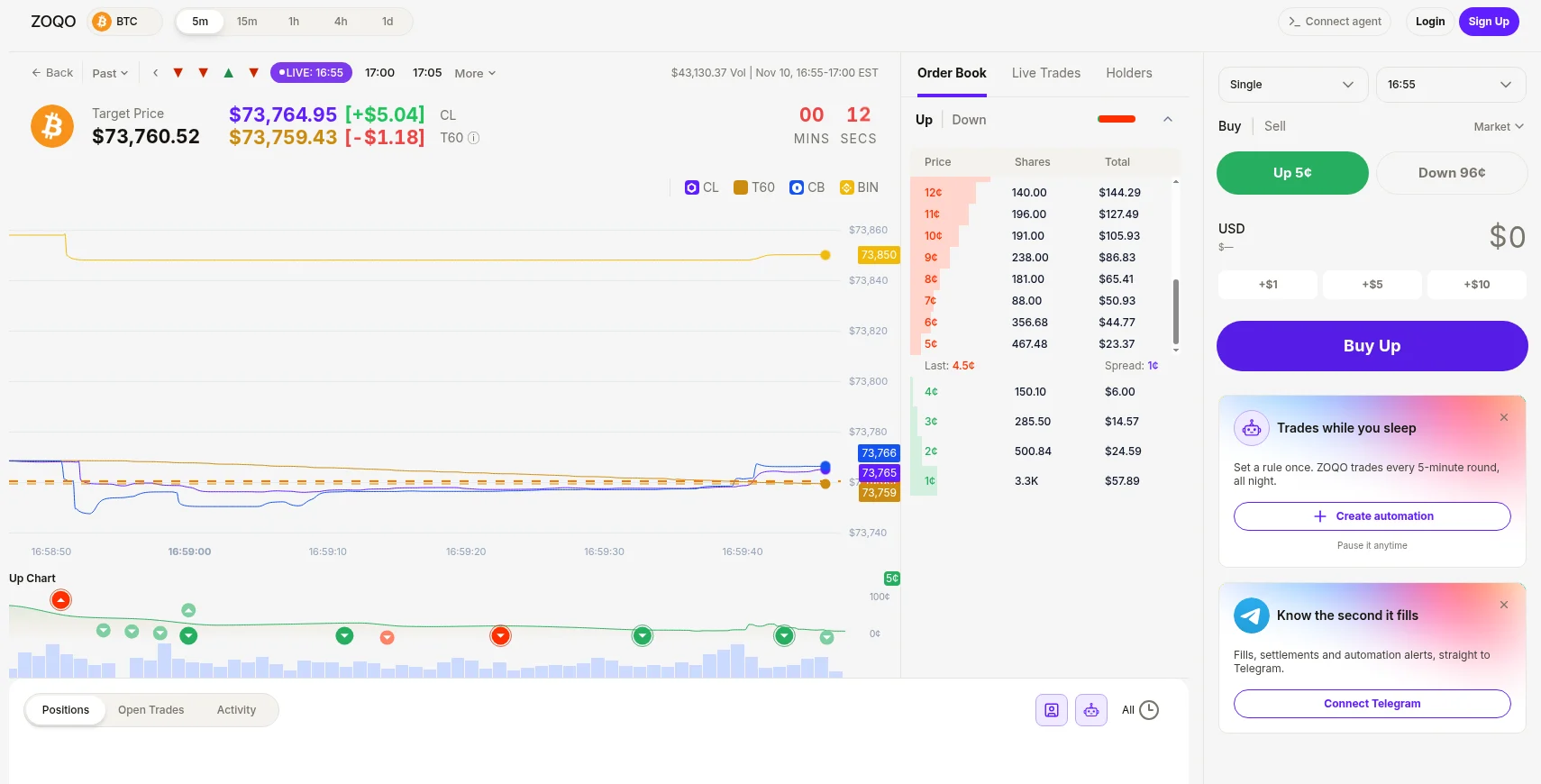
A live BTC 5 minute market on November 10, 2026, at about 4:55 PM ET. Zoqo shows the price to beat as "Target Price" ($73,760.52) and draws it on the chart as the Target line.
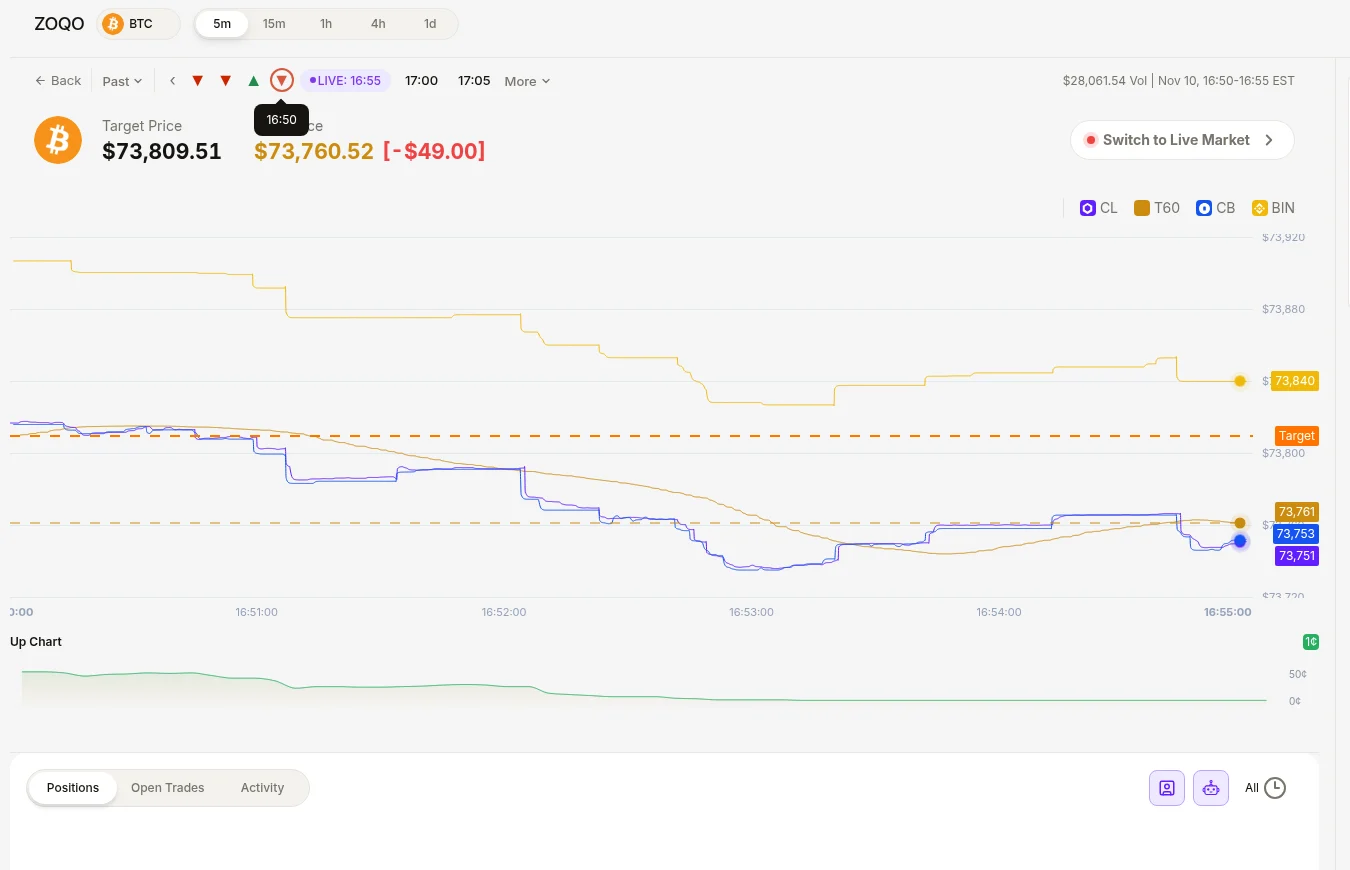
The 4:50 to 4:55 PM ET bucket after close: Target Price $73,809.51, final value $73,760.52, resolved Down.
How should you read a bucket while it is running?
Mid bucket, what matters is the distance between the current settlement value and the price to beat, and how much time is left. A $20 gap means much more with ten seconds to go than with four minutes. Because the final price is an average over its window, the last few seconds of spot movement do not pass one for one into it.
Why does the price to beat say "Pending"?
Sometimes the Target Price, or the final price, reads "Pending." That is expected, and it has two causes.
The first is upcoming buckets. A bucket that has not started has no price to beat yet, because the value at its start does not exist. On November 10, 2026, the upcoming 5:05 to 5:10 PM ET bucket showed "Pending" for its Target Price while the running T60 value was still displayed, and its chart read "Chart data is not available."
The second is publication timing. Polymarket's published settlement values can arrive after a short bucket has already closed. Zoqo's architecture notes record a measured lag of roughly 10 minutes on 5 minute markets in one example. That is an observation, not a guaranteed delay, and it can vary. Zoqo shows "Pending" rather than estimating a value it has not received.
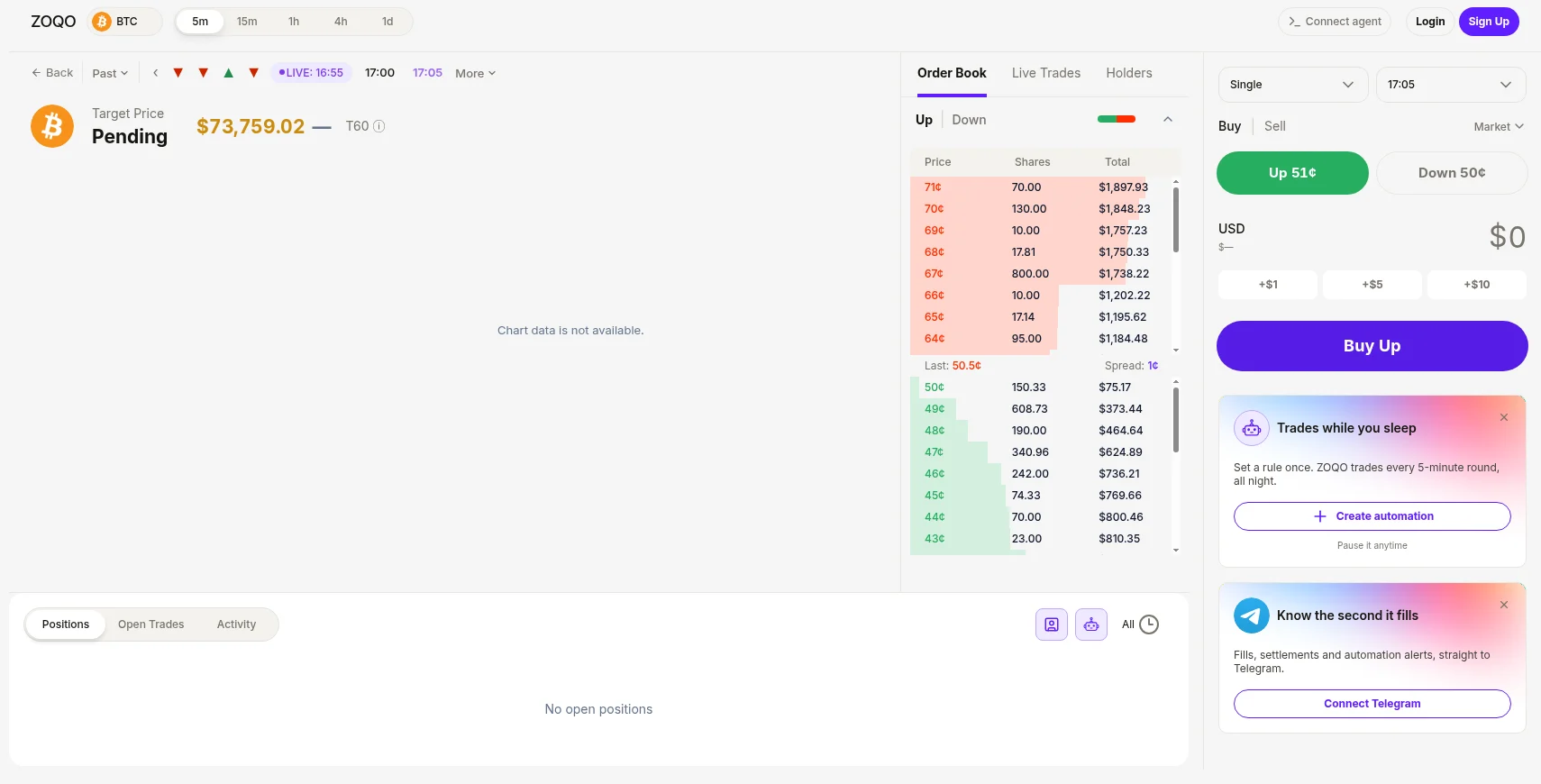
An upcoming 5 minute bucket (5:05 to 5:10 PM ET, November 10, 2026). The Target Price reads "Pending" because the bucket has not started.
Which chart lines decide the market?
On a 5 minute market, Zoqo's chart draws lines labeled CL, T60, CB, and BIN, plus the Target line. In Zoqo's code, CL is Chainlink's spot BTC/USD feed and T60 is the 60 second Chainlink average the 5 minute market settles on. CB is Coinbase BTC/USD and BIN is Binance BTC/USDT. Zoqo's site describes the lines other than T60 as reference.
Spot prices on major venues can sit visibly apart from the Chainlink values, and the market does not resolve on Coinbase or Binance. If one of those lines crosses the Target line and the settlement value does not, the settlement value decides.
The chart legend on a live 5 minute market. Coinbase (CB) and Binance (BIN) lines are for reference; they are not the settlement price.
Tip
On a 5 minute market, watch T60 against the Target line. Spot lines from Coinbase or Binance can cross the Target without changing the result.
Do you have to hold until resolution?
No. You can sell an Up or Down position at any time before resolution, at whatever the bid will pay, less the taker fee if you sell into it. The order book post covers why the bid you can sell into is not the number displayed on the market. Holding to the end means accepting the settlement value as computed, including the averaging and the tie rule.
Zoqo lists these Polymarket BTC Up/Down markets on desktop web, with the Target Price, the Chainlink based values, and the reference lines on one screen. Trading is subject to Polymarket's regional restrictions; in restricted regions the app is view only. For the basics of outcome tokens and resolution, start with how prediction markets work. For the market structure context, see why crypto Up/Down markets are becoming a derivatives market.
Frequently asked questions
What is the price to beat on a Polymarket BTC Up/Down market?
It is the BTC value at the start of the bucket. The market resolves Up if the final price is equal to or greater than it. Zoqo labels it "Target Price." On all five timeframes, both values come from the Chainlink BTC/USD TWAP-60s feed.
Why does a BTC Up/Down market resolve without a dispute period?
The settlement inputs and the comparison are fixed before the market opens, so there is nothing for a proposer to argue about. Event markets go through UMA's proposal and challenge process. Up/Down markets resolve from the published settlement values instead, without that proposal and dispute step.
Can the Coinbase or Binance price decide the outcome?
Not on these BTC Up/Down markets, which settle on Chainlink TWAP. Coinbase and Binance lines on Zoqo's chart are reference only.
Why is the final price still Pending after the bucket ended?
Polymarket's published settlement values can arrive after a short bucket closes. Zoqo shows "Pending" until it receives the value instead of estimating one.