How Prediction Markets Work: Prices and Probabilities Explained
A prediction market prices a question by letting traders buy and sell tokens that pay $1 if an outcome happens. On Polymarket those tokens are Yes and No, the share price is the implied probability, and a winning share redeems for $1 when the market resolves.
A prediction market prices a question with a fixed set of outcomes by letting traders buy and sell tokens that pay out if a given outcome happens. On Polymarket, a binary market has two outcome tokens, Yes and No. Shares trade between $0.00 and $1.00. A winning share redeems for $1.00 when the market resolves, and a losing share is worth $0.00. Because the payout is $1, the price is an implied probability: a Yes share at 65¢ means the market is pricing roughly a 65% chance that the event happens.
What are Yes and No outcome tokens?
Polymarket uses pUSD, an ERC20 token on Polygon backed by USDC, as collateral. Its Positions & Tokens documentation states that a complete Yes/No set is backed by 1 pUSD. Splitting 1 pUSD creates one Yes and one No, and merging an equal number of Yes and No tokens returns the pUSD. One side normally pays $1 at resolution and the other pays nothing, so a complete set is worth $1 at the end in either case.
Most traders never split anything. They trade on the order book. Polymarket's order book docs describe how a new market gets its first price: one trader bids 60¢ for Yes, another bids 40¢ for No, and because the bids add up to $1.00 they match. One pUSD of collateral creates a complete set, and each buyer receives their side. After that, most trading is existing tokens changing hands between users, not against a house.
The two prices are two sides of the same $1 of collateral. If Yes is 65¢, No is economically the remaining 35¢ of a $1 set. The quotes will not always sum to exactly $1, because each side has its own bid and ask.
How do you read a prediction market price as a probability?
Illustrative prices, not live market data:
| Example: 100 shares | Buy Yes at 65¢ | Buy No at 35¢ |
|---|---|---|
| Cost before fees | $65.00 | $35.00 |
| Implied probability | 65% | 35% |
| Payout if this side wins | $100.00 | $100.00 |
| Profit if this side wins | $35.00 | $65.00 |
| Loss if this side loses | $65.00 | $35.00 |
On November 10, 2026, at about 4:55 PM ET, Zoqo's ticket on a BTC 5 minute Up/Down market showed Up at 16¢ and Down at 85¢. Entering $10 on Up showed an average price of 16¢ and "To Win" of $62.50, or 62.5 shares paying $1 each if Up wins. The two quotes summed to $1.01 because each is the price to buy that side, not a midpoint.
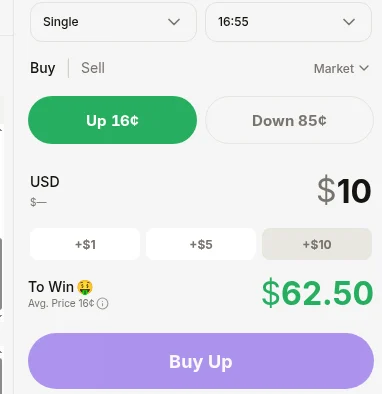
A BTC 5 minute market on November 10, 2026, at about 4:55 PM ET. Up at 16¢ and Down at 85¢ read as implied probabilities of about 16% and 85%.
Buying Yes at 65¢ only has positive expected value if you think the true probability is above 65%. If you think it is 70%, your expected payout is 70¢ per share against a 65¢ cost, an edge of about 5¢ before costs. Polymarket's crypto taker fee at 65¢ is $1.59 per 100 shares according to its fee table, roughly 1.6¢ per share, which is close to a third of that edge before you count the spread.
Tip
Fees and the spread can take a large share of a few cents of apparent edge. Compare your view with the full cost, including fees and spread, not only the displayed price.
Can you sell a position before the market resolves?
Outcome tokens can be sold at any time before the market resolves. In Polymarket's own example, you buy Yes at 40¢, the price rises to 70¢, and selling locks in 30¢ per share without waiting for the outcome. Once the market resolves, trading stops and remaining positions are redeemed.
How do Polymarket markets resolve?
Polymarket documents two resolution systems on its Resolution page.
Event markets resolve through the UMA Optimistic Oracle. Anyone can propose an outcome by posting a bond, typically $750 pUSD, which opens a two hour challenge period. If nobody disputes, the market resolves about two hours after the proposal. A dispute starts a second proposal round, and a second dispute escalates to a vote by UMA token holders, which can stretch resolution to four to six days. The rules text, not the title, defines how a market resolves. In the rare case that neither outcome applies, a binary market can resolve to a split payout; in UMA's 50/50 case each token redeems for $0.50.
Up/Down markets cover an asset, a start time, and a duration. Polymarket's page describes a Chainlink time weighted average price (TWAP) at the start setting the price to beat, and the TWAP at the end setting the final price. The market resolves Up if the final price is equal to or greater than the price to beat and Down if it is lower, with no proposal or dispute step. The outcomes are labeled Up and Down instead of Yes and No, but the token logic is the same. Check each market's rules text for how that market's prices are set.
Zoqo lists Polymarket's BTC Up/Down markets in five timeframes, from 5 minutes to 1 day. For the market structure side of these contracts, see Why crypto Up/Down markets are becoming a derivatives market. The next post in this series covers how Polymarket's order book works, including why the displayed price is not your fill.
Frequently asked questions
What does a prediction market price mean?
It is the market's implied probability of that outcome, because a winning share redeems for $1. A Yes token at 65¢ is the market pricing roughly a 65% chance the event happens. It is a traded price, not a guarantee that 65% is the true probability.
What happens if I buy Yes and the event happens?
Each Yes share redeems for $1.00 in pUSD when the market resolves. Your profit is $1.00 minus the price you paid, minus fees and any spread you crossed to get the fill. If the event does not happen, the Yes share is worth $0.00.
Can I exit before resolution?
Yes. You can sell your tokens on the order book at any time while the market is still trading, which lets you lock in a gain or cut a loss without waiting for the outcome. After resolution, trading stops and remaining positions are redeemed.
How is an Up/Down market different from an event market?
The token logic is the same, but resolution is not. Event markets use the UMA Optimistic Oracle, which can include a challenge period or a vote. Up/Down markets resolve from a start price and a final price, with Up winning if the final price is equal to or greater than the price to beat.