How Polymarket's Order Book Works: Spread and Slippage Explained
The price shown on a Polymarket market is usually not the price you will trade at. A buy pays the ask, a sell receives the bid, and on a thin book the rest of your size walks the next levels. That walk is slippage.

The price shown on a Polymarket market is usually not the price you will trade at. Polymarket displays the midpoint between the best bid and the best ask, but a buy order pays the ask and a sell order receives the bid. In Polymarket's own example, a Yes token with a 34¢ bid and a 40¢ ask displays as 37¢, and a buyer still pays 40¢. That 3¢ gap is one cost of trading immediately. If your order is larger than the size at the best price, walking the next levels is another.
How does Polymarket's order book work?
Polymarket runs a central limit order book (CLOB), described in its Prices & Orderbook documentation. Each market's book lists every open order: bids (buy orders, best price highest) and asks (sell orders, best price lowest). The spread is the gap between the best bid and best ask, and a tighter spread generally means a more liquid market. Polymarket does not set prices. They come from traders' orders.
Polymarket calls the design hybrid decentralized: an operator matches orders off chain, and matched trades settle on chain through smart contracts, with traders keeping custody of their assets until settlement.
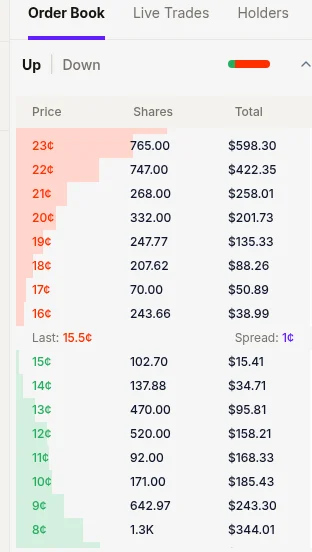
The Up book on a BTC 5 minute market, November 10, 2026, at about 4:55 PM ET. Asks (red) above, bids (green) below: best ask 16¢, best bid 15¢, Spread 1¢.
Why is the displayed price different from your fill?
Polymarket's displayed price is normally the midpoint of the best bid and the best ask. If the spread is wider than $0.10, the last traded price is shown instead. Using the documented example:
| Price | |
|---|---|
| Best bid (Yes) | 34¢ |
| Best ask (Yes) | 40¢ |
| Displayed price: (34 + 40) / 2 | 37¢ |
| What a buyer pays | 40¢ |
| What a seller receives | 34¢ |
A trader who reads "37%" and buys at market pays 40¢, three cents above the displayed price, or about 8% more than the mid for the same $1 payoff. If you then sold immediately at the 34¢ bid, the round trip would cost 6¢ per share before fees.
When the spread is wider than 10¢, the displayed number is the last trade, which may be stale and can sit anywhere relative to the current bid and ask. The book itself is then the only reliable reference.
Zoqo presents this slightly differently. Its order book shows "Last" (the last traded price) and "Spread," with no separate midpoint label, and the order ticket quotes the price you would pay. On a BTC 5 minute market on November 10, 2026, at about 4:55 PM ET, the Up book had a best bid of 15¢ and a best ask of 16¢, with Last at 15.5¢ and Spread at 1¢. Entering $10 to buy Up showed "Up 16¢" and an average price of 16¢: the ask, not the last trade. Last happened to sit exactly at the midpoint in that snapshot, but it is a record of a trade, not a quote, and the two will not always coincide.
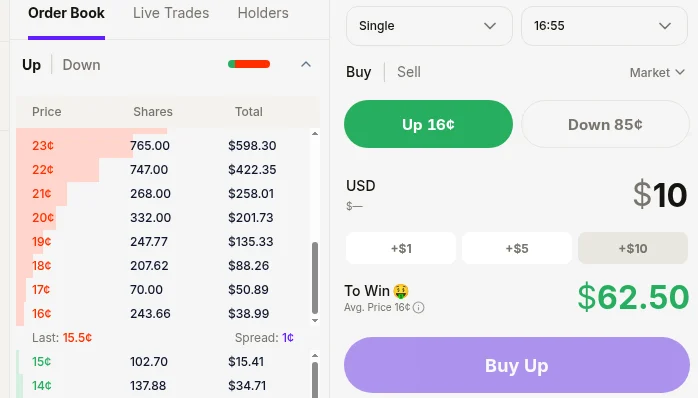
Same snapshot: the book's Last is 15.5¢, while the ticket's buy price and average price are the 16¢ ask.
Are market orders limit orders?
Polymarket's docs say all orders are technically limit orders. A "market order" is a limit order priced to execute immediately against resting orders.
A limit order executes only at your price or better. If no one is selling at your price, it rests in the book until someone trades against it. It can fill in pieces as different traders match portions of it, and you can cancel whatever has not filled. An order that rests in the book and later fills is a maker order. An order that crosses the spread and takes resting liquidity is a taker order, and on crypto markets that charge fees, only takers pay Polymarket's trading fee.
A market order trades certainty of execution for less control over price. A buy pays the best ask, then the next ask up, and so on until it is filled or reaches the limit price it carries.
What is slippage, and why does a thin book matter?
The best ask only applies up to the size resting at that price. Polymarket's docs note that there are no trading size limits, but that large orders can move the price significantly and that you should check depth before trading in size.
Continuing the 34¢/40¢ example with a hypothetical ask side:
| Ask price | Shares available |
|---|---|
| 40¢ | 100 |
| 42¢ | 150 |
| 45¢ | 300 |
A market buy for 400 shares fills 100 at 40¢, 150 at 42¢, and 150 at 45¢, for a total of $170.50 and an average price of about 42.6¢. The displayed price could still read 37¢. That 5.6¢ gap between the display and your average fill is the combined cost of the spread and slippage, before any fee. On a thin book, your average price depends heavily on your size, and that cost comes out of whatever edge you think you have.
Thin books affect exits too. If you plan to sell before resolution, check that the bid side can absorb your size at a price you can accept, and do that before you enter.
On Zoqo, market orders are sent as fill and kill: the order takes the liquidity available within its price and cancels the rest, so partial fills are possible and the app shows them.
Tip
The number on the market is not your fill. A buy pays the ask, a sell receives the bid, and size beyond the top of the book walks the next levels. Read Last and Spread as context, and check depth before you send size.
This is the second post in a short series on prediction market mechanics. The first covers how prediction markets work, including outcome tokens, implied probabilities, and resolution.
Frequently asked questions
Why did I pay more than the price I saw on the market?
Polymarket usually displays the midpoint between the best bid and the best ask, not the price a buyer pays. In its documented example, a 34¢ bid and a 40¢ ask display as 37¢, and a market buy still pays 40¢. On Zoqo, the ticket quotes the ask you would pay, and the book shows Last and Spread, not a midpoint.
What is the spread?
The spread is the gap between the best bid and the best ask. A tighter spread generally means a more liquid book and a lower immediate cost to trade. When the spread is wider than 10¢, Polymarket shows the last traded price instead of the midpoint, which can be stale.
What is the difference between a maker and a taker?
A maker posts an order that rests in the book and later gets filled. A taker crosses the spread and trades against a resting order. On crypto markets that charge fees, only takers pay Polymarket's trading fee.
What is slippage?
Slippage is the difference between the first available price and the average price you get when your order walks more than one level of the book. In a thin book, a larger order can move well past the best ask or bid, and that gap comes out of your edge before fees.