5m vs 15m vs 1h vs 4h vs 1d BTC Up/Down Markets Compared
How Polymarket's 5 minute, 15 minute, 1 hour, 4 hour, and daily BTC Up/Down markets compare: window length, fees, execution time, and the November 18 move of 1-hour and daily markets to Chainlink.
Polymarket runs BTC Up/Down markets on five timeframes: 5 minutes, 15 minutes, 1 hour, 4 hours, and 1 day. Each one asks whether Bitcoin finishes the window at or above where it started, and the winning side redeems for $1. The 5-minute, 15-minute, 1-hour, 4-hour, and daily markets settle on Chainlink's BTC/USD TWAP-60s feed, and an exact tie resolves Up. The timeframe still changes how many windows you face, how long each order book stays open, and how far BTC can move before resolution.
How do the five BTC Up/Down timeframes compare?
The settlement columns below come from the rules text on Polymarket's live BTC Up/Down markets, checked on November 18, 2026, including the current 1-hour market and the daily market that ends at noon ET on November 19.
| Timeframe | Window | Windows in a full day | Settles on | Exact tie |
|---|---|---|---|---|
| 5m | 5 minutes | 288 | Chainlink BTC/USD TWAP-60s | Up |
| 15m | 15 minutes | 96 | Chainlink BTC/USD TWAP-60s | Up |
| 1h | 1 hour | 24 | Chainlink BTC/USD TWAP-60s | Up |
| 4h | 4 hours | 6 | Chainlink BTC/USD TWAP-60s | Up |
| 1d | Noon ET to noon ET | 1 | Chainlink BTC/USD TWAP-60s | Up |
The window counts are arithmetic. Each window is its own market with its own order book, liquidity, and resolution time, so someone trading every 5-minute window is dealing with hundreds of separate markets a day.
The rules say the market resolves Up if the time-weighted average price of Bitcoin, generated by Chainlink, over the window "is greater than or equal to the price at the beginning of that range." The named source is Chainlink's BTC/USD TWAP-60s data stream. Polymarket's Resolution page describes Up/Down markets the same way. TWAP-60s means a 60-second average immediately before the start and immediately before the end, not an average across the whole 5-minute, 1-hour, or daily window. Because the rule is "greater than or equal to," an exact tie resolves Up.
When did the 1-hour and daily markets move to Chainlink?
The 5-minute, 15-minute, and 4-hour markets already settled on this Chainlink feed. On November 18, 2026, at 00:00 UTC (November 17 at 7:00 PM ET), Polymarket moved the international 1-hour and daily crypto Up/Down markets from Binance candles to the same Chainlink USD TWAP-60s feeds, according to Polymarket Developers.
The last Binance-based markets were the 1-hour market at 6:00 PM ET on November 17 and the daily market ending at noon ET on November 18. The first Chainlink daily BTC market ends at noon ET on November 19. Its rules compare the Chainlink BTC/USD TWAP at noon ET on November 18 with the TWAP at noon ET on November 19, and it resolves Up if the later value is greater than or equal to the earlier one.
Two things changed in that move. The old 1-hour markets compared the open and close of Binance's BTC/USDT 1-hour candle, and the old daily markets compared the close of Binance's BTC/USDT 1-minute candles at noon ET on consecutive days. Those were single candle prices. The new markets use a 60-second average at each end. The daily tie rule also changed: an exact tie on the last Binance daily market resolved 50-50, and an exact tie on the new Chainlink daily market resolves Up. The daily window itself is unchanged. It still runs from noon ET to noon ET, and a market named for a date ends at noon ET on that date.
What changes on a 5-minute market?
A 5-minute market gives you very little time to act on a view. If you enter two minutes in, you have three minutes for the price to move your way and for a buyer to be there if you want out before resolution. A market order fills against whatever is resting. A limit order may not fill before the window ends, and trading stops at resolution.
Fixed costs also weigh more. The spread and the taker fee are paid on every trade, and since November 20, 2026, the taker fee is higher on the short windows. BTC 5-minute and 15-minute markets use a fee rate of 0.05, which peaks at 50¢: $1.25 per 100 shares, or 2.5% of the position on each side. The 1-hour, 4-hour, and daily markets use 0.01, which peaks at $0.25 per 100 shares, or 0.5%. A round trip near even odds pays that twice, plus any spread crossed, and the move that covers it has to happen within minutes. Our explainer on Polymarket taker fees works through the formula.
Settlement data can lag a short window. Published settlement values sometimes arrive after a 5-minute market has already closed, and Zoqo shows "Pending" while a value is outstanding. On a daily market a delay of a few minutes is a small part of the window. On a 5-minute market it can be longer than the window itself.
What changes on 4-hour and daily markets?
A 4-hour or 1-day window gives you hours to work an order. You can rest a limit order and wait for it to fill, which makes you the maker and avoids the taker fee. You can also revisit the position as news and price action come in. Taker fees are lower too: the 0.01 rate on these markets is a fifth of the 5-minute and 15-minute rate. The cost is that BTC has much more room to move inside one window, so Up and Down prices can drift a long way from 50¢.
On the afternoon of November 10, 2026, before the daily market moved to Chainlink, Zoqo's 1d BTC market showed a Target Price of $72,974.83, a running value $913.00 above it, and about 19 hours left. The ticket quoted Up at 79¢ and Down at 22¢. A $913 lead with most of a day remaining still left Down priced at roughly a one-in-five chance. The running value on that screen is labeled BIN, which matched the Binance settlement source those daily markets used at the time.

The 1d BTC market on the afternoon of Nov 10, 2026, before daily markets moved to Chainlink: Target Price $72,974.83, running value +$913.00 labeled BIN, Up 79¢ and Down 22¢.
Does one window's final price become the next window's price to beat?
On the 5-minute markets it does. On November 10, 2026, the 4:50 to 4:55 PM ET window closed at $73,760.52, and the 4:55 to 5:00 PM window opened with a Target Price of exactly $73,760.52. A sharp move late in one window becomes the starting line for the next, so the next window opens with BTC sitting right at its price to beat.
The daily market's rules chain the same way. They compare the Chainlink TWAP at noon ET on one day with the TWAP at noon ET on the next, so the value that ends one day's market is the value that starts the next day's market.
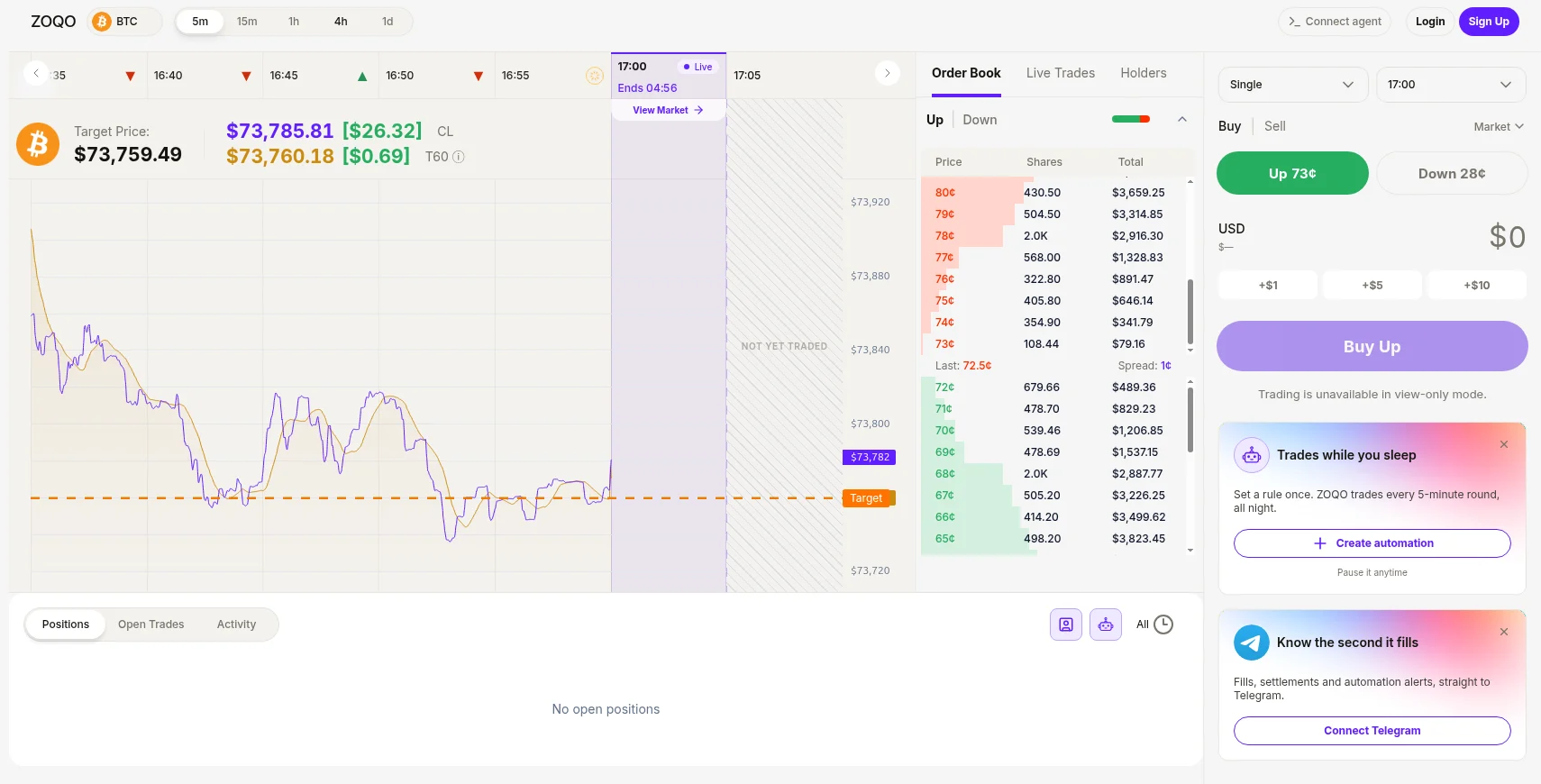
The 5m window strip on Zoqo, with the timeframe pills at the top: past windows marked ▲ (Up) or ▼ (Down), the Live window, and upcoming windows marked NOT YET TRADED.
How should you pick a timeframe?
Pick it by how you want to execute. Short windows give you many separate markets and quick resolution, but each one leaves only minutes to act, and fees and spread are large next to the moves you are trading. Long windows let you use limit orders and exit on your own schedule, but you carry BTC exposure for hours and prices often sit far from even odds.
Tip
Open the rules on any timeframe you haven't traded before. The settlement source, start and end times, and tie rule are all written there.
Where can you trade all five timeframes?
Zoqo lists all five BTC Up/Down timeframes on desktop web, switched with the 5m, 15m, 1h, 4h, and 1d pills at the top of the markets page. Each market shows its Target Price, the running value against it, and the order book on one screen. Trading is subject to Polymarket's regional restrictions, and in restricted regions the app is view only. For how a single window resolves, see how Polymarket's BTC Up/Down markets work, and for reading the book, see how Polymarket's order book works.
Frequently asked questions
Do all BTC Up/Down markets settle on Chainlink?
Yes. The 5m, 15m, 1h, 4h, and 1d markets all settle on Chainlink's BTC/USD TWAP-60s feed. The 1-hour and daily markets moved to that feed on November 18, 2026. The last Binance daily market is the November 18 market, which ends at noon ET on that date.
What happens if the final price equals the price to beat?
A tie resolves Up on all five timeframes, because the rule is "greater than or equal to." Before the move to Chainlink, an exact tie on the daily market resolved 50-50.
When does the daily BTC Up/Down market start and end?
It runs from noon ET one day to noon ET the next. The market named for a date ends at noon ET on that date.
Which timeframe has the lowest fees?
The 1-hour, 4-hour, and daily markets. Since November 20, 2026, Polymarket's taker fee rate is 0.01 on those and 0.05 on the 5-minute and 15-minute markets, so a 50¢ taker trade costs $0.25 per 100 shares instead of $1.25. Longer windows also give a resting limit order more time to fill as a maker, and makers pay no platform fee.